Introduction
Ah, Action 52--the freak misfit of video games. This compilation of "games" is one of the most infamous that has ever graced our game systems.
Created by a company called Active Enterprises, Action 52 was a compilation of 52 "new and original" action-packed games bundled in one
cartridge, with an asking price of
$199! If you think that's exorbitant, let's put that into context: A normal, standalone NES game in
1992 had an average retail price of $60. If you bought 52 of these individual games together, before tax, it would be a
$3,120 expense!
Active Enterprises' mentality was that more games stuffed in a single cart would garner more green, they just had to ask for a slightly higher
price. So if you divide its retail price by 52 games, including tax, that's
$4 a game! That's an excellent deal...
...if the games weren't disasters.
Every video game has its flaws, even the most classic, most popular ones. Sometimes there's programming mistakes here and there that don't
always detract from the game as a whole. Even master programmers can forget about a few things in coding that cause relatively benign issues.
But in Action 52, pretty much every video game flaw imaginable is present in one form or another in each game: the graphics are bad, the audio
is terrible, gameplay ranges from bad to unplayable, the controls are broken, some games are too hard or easy, not fun at all, make no sense,
and overall are not worth your time.
But you might be asking, "Why would they dare make something so despicable? Why would they damage the psyches of innocent lives just to make a
quick buck?" Well, let's dig in... LIGHTS! CAMERA! ACTION!... 52.
The Concept
In about 1990, there was an investment banker called Vince Perri whose 9-year-old son loved video games. He was playing an unlicensed 40-game
multicart from Taiwan, and the whole neighborhood was marveled by it. Vince decided that he could do this kind of thing legally, albeit in an
unauthorized way, and wanted to create a cheaper option for those who didn't want to spend so much money on games. He raised $5,000,000 from
European and Saudi Arabian bankers to begin a new company called Active Enterprises. Occasionally, he would borrow office space at a
recording studio in Miami to discuss business plans. It was there that employee and recent college graduate in audio and video production
Mario Gonzalez took interest in his endeavor, after overhearing the story with his kid playing that 40-in-1. Mario says he had some
experience in programming and music composition, along with his friend Albert Hernandez. They decided to call another mutual friend, Javier
Perez, who was also experienced in music composition and art design. Just hired, the team demonstrated their video game making abilities by
creating a demo game of Tetris called "Mega-Tris", on an Amiga 500. Impressed by the graphics and sound used (even though this hardware is
more sophisticated than the NES, but don't tell Vince that!), the team signed contracts and were then sent to Salt Lake City, Utah to learn
how to program for the console. But they only had a week or two to do so, as Vince was in a hurry to start making money! This is where the
real action begins...
The Development
After having been trained, Vince Perri instructed the group to work on a multicart with 52 games called Action 52, in a three-month period.
Meanwhile, one other developer (who met the other three a few years prior at this very studio) learned about this endeavor and starting
visiting the crew. His name is unknown, but a Miami Herald article from July 1993 has me speculate that his name is Joey Martinez. Anyway,
he eventually joined them to work on art and level design. Mario began work on a list of games to include on the cartridge, a couple of
which have their own particularly interesting stories. In addition, pictures of other pages in his notebook were shown to have a list of
games to draw inspiration from, a drawn-up concept of an ultimately scrapped game "Duck Droid", and an early concept for "Dedant".
Scrapped Concepts
During development, Mario jotted down a bunch of games from which to incorporate concepts and mechanics into his games. In
addition, there were envisioned premises for games that were ultimately scrapped. Some were even mentioned in the final
manual while the games themselves were totally different, but we'll get back to that. And knowing how tall a task creating 52
games would be, Mario created a bunch of game engines and templated graphics to save memory and time. For example, he wanted
to put in a game like Combat on the Atari VCS where two players controlled a tank and shot at each other. This was actually
brought to life in the final product's first game, Firebreathers. Then, Mario wanted some shoot-em-ups in the compilation, and
so a QUARTER of the cartridge was space shooters.
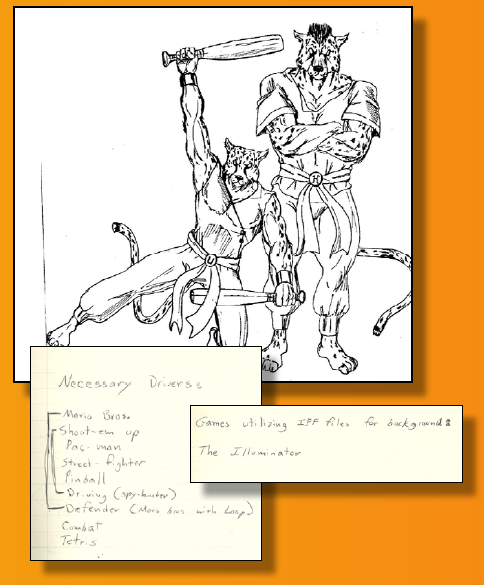
According to Mario, the original concept for Dedant was to grab food and take it the queen while avoiding insects. You could
travel through a big underground ant farm (seen in the sketches) which scrolls in all four directions as you move through it.
The final version just involved an ant at the bottom of the screen shooting at other ants and spiders.
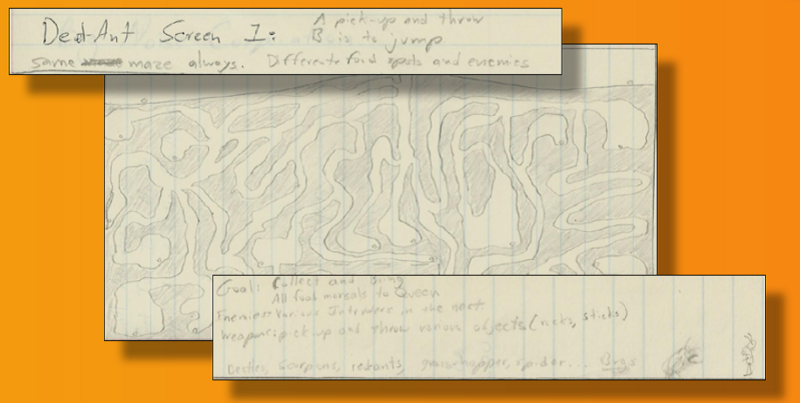
This was a completely scrapped game called "Duck Droid", where you would've played as a duck wearing a jetpack. It would've
worked something like a mix between Gravitar and Balloon Fight, where you run around on ground and press a button to propel
yourself in the direction you're facing. And as the writing says, the screen would scroll like in Defender to make for a large
environment to explore. I'm not sure why this didn't come to fruition, but it may have been due to lack of time.
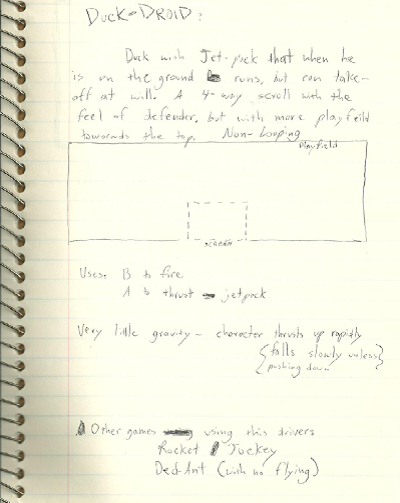
This was Mario's list of game names, which I consider one of the most interesting things related to Action 52's development.

| Written Name |
Eventual Fate & Extra Notes |
Ooze |
Would appear in final product. |
| Rty and the Ink Men |
Would be scrapped; Mario says it should've been spelled "Art-y" and was never meant to be in Action 52. He felt Art-y could've
been a good standalone game, so he saved this for a future project. Eventually, Mario Paint came out and stole his envisioned
concept. |
Boss |
Would appear in final product as a normal game, but served as an even earlier concept for game #52, where you fight the bosses
of the rest of the games. This evolved into Action Gamemaster, mentioned below. |
| Dead-Ant |
Would appear in final product, spelled "Dedant", with the aforementioned early premise. |
| Volatile |
Scrapped. |
| Mash-Man |
Would appear in final product, with no dash. |
| Rocket-Jockey |
Would appear in final product, with no dash. |
| Streamers |
Would appear in final product, spelled "Streemerz". |
| Power Throne |
Scrapped. |
| Silver Sword |
Would appear in final product. |
Locked Away Since 1990
Before we go further, let me tell you about a businessman called Greg Pabich. In the 1990s, he owned a big preplayed movie
and game distributor in Dallas, Texas. Greg created game resale programs for such chains as Babbages (these days known as
GameStop), Toys R Us, and Software Etc. Why am I telling you about some Texas businessman? Well, not long before Action 52
started development, Active Enterprises owner Vince Perri contacted Greg to pitch a deal. Greg felt the deal could be a scam
as it involved buying thousands of games for lots of money. Plus, the games would be assembled offshore and he had to pay in
advance for them. In short, Vince only had a few "prototypes" (one of which he gave Greg), so Greg decided to back out. In
2010, nearly 20 years after this failed deal, he remembered he had this prototype, which featured different menu appearances,
likely even-less-finished games and more! Unfortunately, this whole prototype still has yet to be dumped.
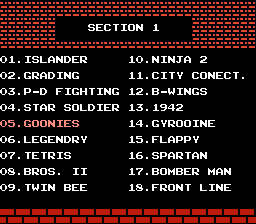
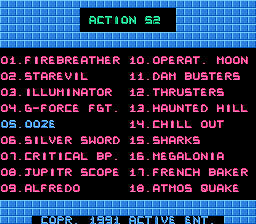
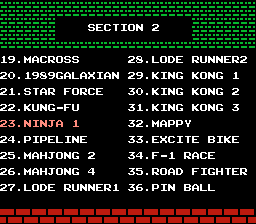
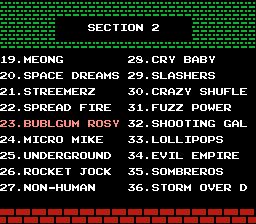
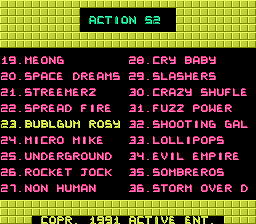
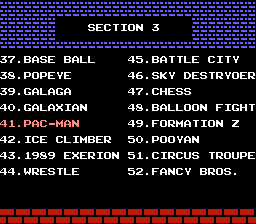
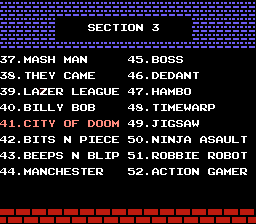
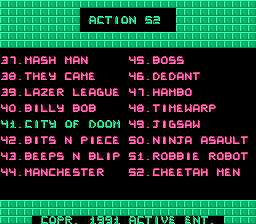
Below is how the menu evolved in each iteration. The first column is how the game menu looked originally on the bootleg this
cart was based on. The second is a *mockup* I made on how they looked with the game names replaced with Action 52's. The last
is the final product's menu:
| 52-in-1 Bootleg |
My Mockup with A52 Names |
Final |
| 
| 
|
| 
| 
|
| 
| 
|
Sure, the names are mostly the same...but wait! What's this
"Action Gamer" game in slot #52?
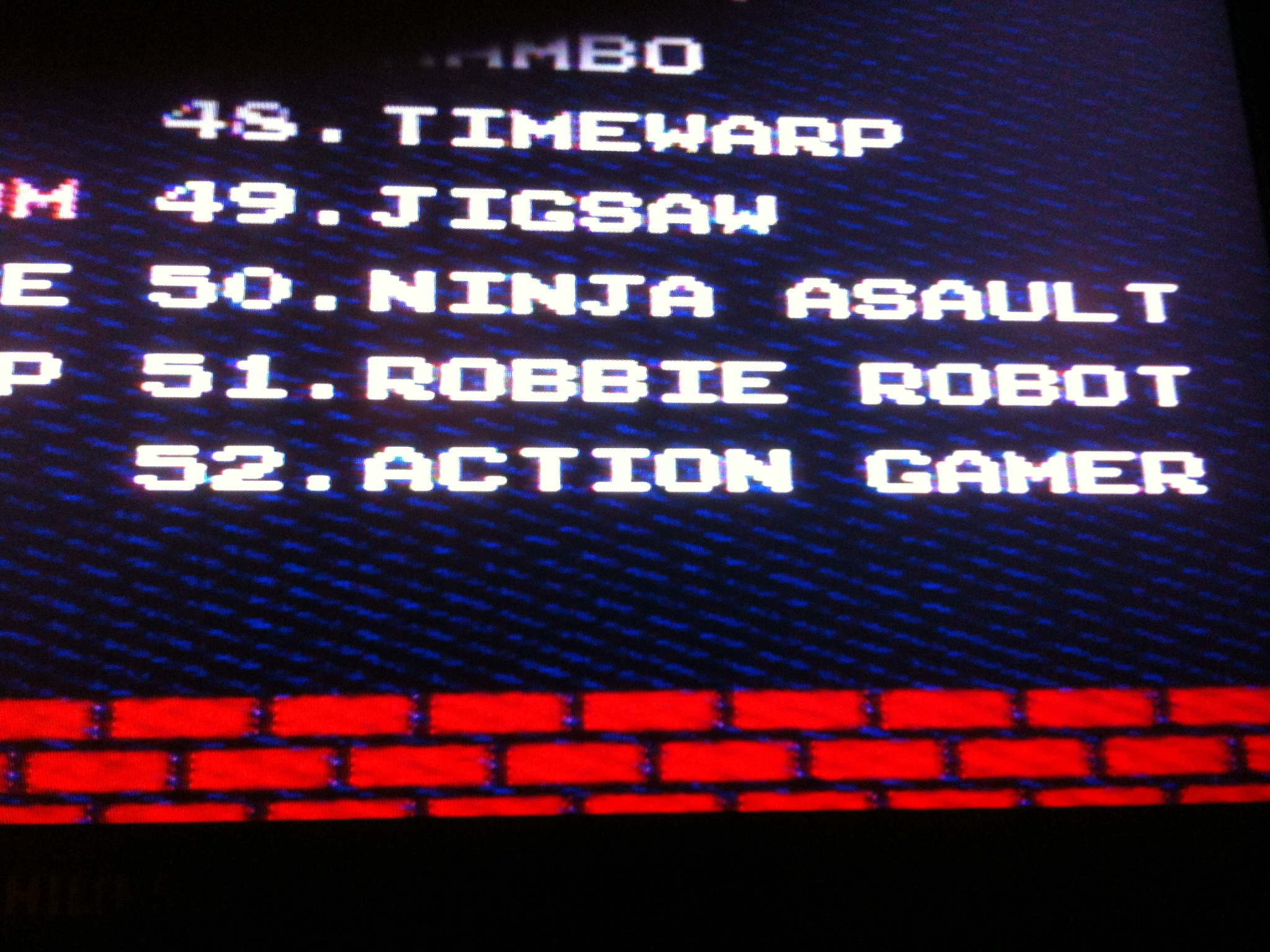
Well, this was actually Mario's second concept for game #52. To gain access to it, you had to defeat the bosses from all the other
games. (The aforementioned prototype featured this early version, which was released on its own by Greg Pabich in 2011 and dumped
by me in 2023. It comprised of just the last level of Ooze and Robbie and the Robots, with the Cheetahmen sprites replacing the
final product's respective sprites.)
But getting back to development, at the time, the Teenage Mutant Ninja Turtles were a mammoth of a franchise, raking in millions
from their action figures, TV show, and video games. So, despite the project being relatively far on, Perri told Mario that he
wanted to make this cartridge a launch pad for a potential competing franchise to TMNT with merchandise of its own, called The
Cheetahmen. Mario decided not to argue, and game #52 was quickly slapped together into The Cheetahmen. Again, due to the lack of
time the programmers had. Here's what I believe happened...
Crunch Time
At the time, there was a cartoon called Captain N: The Game Master, which involved a boy named Kevin who gets pulled into the TV
while playing video games. He then found himself in the video game world with his games' characters. What could have happened was
that as they were working on game #52, Perri chimed in and told them to use the rest of their development time to incorporate the
Cheetahmen into the plot. But Mario had to hurry to figure this part out, so he took The Game Master plot and made the Cheetahmen
part of the video game world the gamer was pulled into. Then came the short, senseless intro text saying the Cheetahmen explained
the enemies they would fight to... send the gamer back to his world (or something). After the intro, the plot has zero bearing on
the game itself. Finishing the last level just sent the game back to the screen asking how many players.

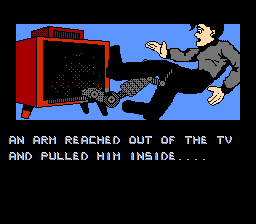
The original plot of this game is a mystery to me on many levels. First, would there have been a plot to Action Gamemaster before
the Cheetahmen idea sprung up? As far as I know, it was just a secret addition, rather than a full-fledged extra game that it
became. Second, if the change was ordered but there was no time crunch, what would've been the actual in-game plot, if not the
comic book's? This whole thing serves as a telltale sign of crazy ambitions and awful execution on Vince Perri's part.